
Our events programme gets a little quieter in the summer, though we have just arranged to bring Samira Ahmed (the BBC Front Row presenter) to bring a bit of Beatle-mania to the shop on August 11th with an illustrated talk on the film of A Hard Days Night. Our book groups continue over the summer, and in the next few weeks we have the launch of one of our own Five Leaves New Poetry pamphlets by Diana Bosworth, the launch of our book Caribbean Pioneer Gardeners: Hungerhill Gardens, St. Ann’s Allotments, Nottingham by Colin Haynes and a talk by our own Sarah Wilson on Homer’s Odyssey. Wait, that’s supposed to be us being quieter… And then it’s September and we have a course on writing horror. Find all of these, as ever, on our website.
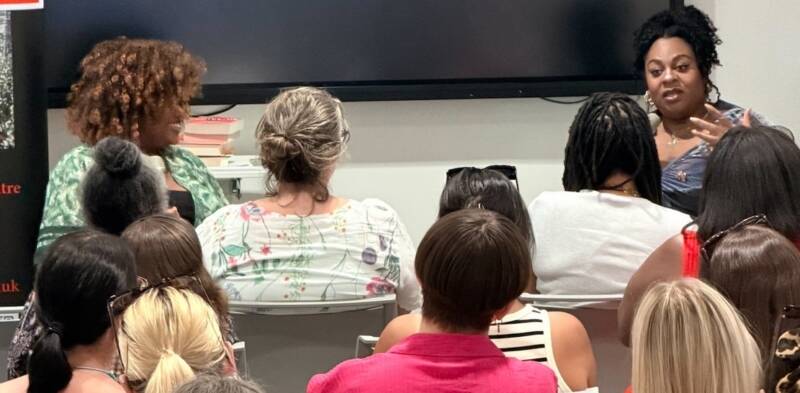
Of the recent events, two of the most memorable were a talk by Aidan Everett on the Latin poet Horace with Aidan’s translations of Horace’s odes and original poetic responses to them. By contrast, last week we welcomed Candice Carty-Williams of Queenie fame being in conversation with Cara Thompson about her new novel featuring the life of a now more mature but still young Black woman.
 Our long-term D.H. Lawrence project is starting to build a bit more of a Lawrence presence in the city. The sixth of our Lawrence-related books is in preparation for September. This one is a pamphlet on Lawrence and Nottingham itself, by John Pateman, looking at the various places Lawrence studied, worked or wrote about in the city. There’s a bookable Lawrence walk in the city centre in September, which follows our Mapperley Lawrence walk which was fully booked. Our biggest publishing contribution though is just being proof-read, a modern version of D.H. Lawrence: a personal memoir by ‘E.T.’, Jessie Chambers, with a new introduction by Kate Foster from the Haggs Farm Preservation Society. That one should come out in October.
 Tony Challis died on Saturday, and over the weekend masses of people in the local literature scene posted material on social media. They outlined how they knew Tony, from Nottingham Poetry Society, from Pink Ink, from Nottingham Writers Studio, from Silver Pride, from Stanza, from Edinburgh Festival, from Nottingham Humanists… If you didn’t know Tony but go to literature events, gay events or theatre you probably sat next to him. There are few people around who had such a big cultural life and his diary was full. We were proud to publish his Five Leaves New Poetry pamphlet Rainbow Candles last year. Tony was one of our most regular customers and a regular at events here.
 |
Many young Jews, particularly in North America, have been exploring “the road not taken” as their Jewish ethics conflict with the Israeli genocide in Gaza. There have been other books on the Bund – the pre-war Polish Jewish socialist organisation, effectively destroyed by the Nazis and Stalin – but this is the one that has broken through to be an essential text for the Jewish peace movement. The Bund ran libraries, theatre groups, youth organisations, sporting groups, women’s organisations… it was secular but physically defended synagogues against Polish fascists. The Bund’s basic position was called “doikeit” – a Yiddish word which this author translates to give her book its title. Molly draws on her own Bundist family background to lead you into her book. It feels – it is – pretty American in style. The Bund does have a continuing organisation in Melbourne, Australia but its ideas are increasingly influential in groups like Jewish Voice for Peace in America.
–Ross
|
 |
Thomas Flett, a young shrimp-scraper, lives a quiet, routine life in a foggy English coastal town until an enigmatic American filmmaker arrives and upends everything. A slim, atmospheric novel with a lyrical quality, all eerie seaside setting, hidden sinkholes and ghostly fog. Longlisted for the 2025 Booker Prize, it’s a haunting, beautifully written novel that looks at class, ambition, and the old put down, ‘know your place’, which always burns when there is nothing you want more than to be somewhere else.
–Carl
|
 |
I am a bit sceptical of A-Zs of anything but this book was a delight to read – witty, informative and often very funny. It’s not just for those wanting to write a memoir but also for memoir readers, with a wide range of memoirs in different styles and tackling different subjects mentioned. The author is a skilled memoirist and covers subjects from Autofiction to Memory to Zzz. As you’re working your way through the alphabet, you might find yourself adding your own entries.
–Giselle
|
 |
Mythographer, storyteller, Eastern Orthodox Christian thinker (and former Pagan reading group pick for his previous book Smokehole) Martin Shaw is deeply concerned that we live in a myth-impoverished age. He argues that we have made an error in discarding completely the slow wisdom of generations-old tales for a total reliance on quick and easy modern convenience and rationality, using stories themselves to show us the error of our ways and persuade us to re-wild ourselves. As a fan of his occasional podcast, I was happy to find he writes just as well as he speaks, and I found it beautiful, convincing and moving work.
–Carl
|
 |
You may notice a theme in what I’ve been reading recently! And if you have a look at our events, you might be able to figure out why. Having studied Homer at school and university, I’ve read and worked with multiple translations. When Emily Wilson became the first woman (in 2017!) to translate the work into English, she made quite a splash. This is also rumoured to be the translation Christopher Nolan worked from for his upcoming blockbuster adaptation. There’s death, sex and gods a-plenty in this epic. A brilliant, accessible, modern translation. If you don’t know where to start with Homer, I would recommend you start with Emily Wilson!
–Sarah
|
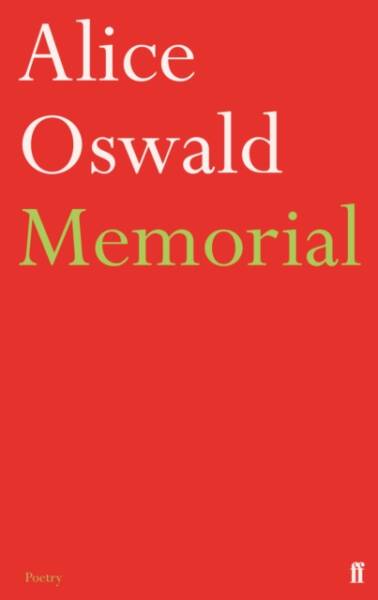 |
Alice Oswald is one of my favourite poets, but I was still a little skeptical when picking up this. A reimagining of The Iliad that the author herself describes as a “reckless dismissal of seven-eighths of the poem”? But Memorial is a stark, affecting ode to the dead. You do not need to have read Homer to be moved by the enargeia- the bright, unbearable reality- of war and grief held in this work.
–Sarah
|
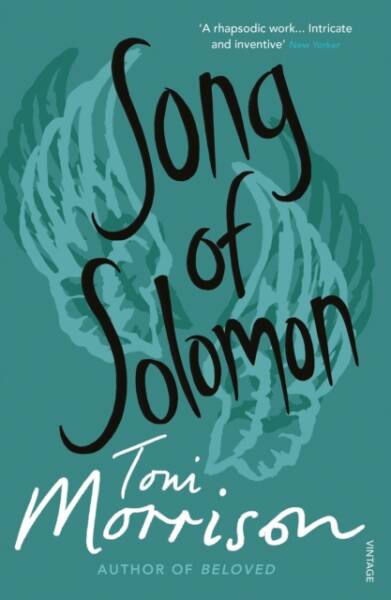 |
Toni Morrison makes me feel like I’ve never read good writing before. We discussed Beloved in our book group last month and I was once again astounded by her craft and genius. I find new things to admire with every read. But I wanted to recommend a different Morrison, which I read for the first time this month- Song of Solomon– a loose reimagining of The Odyssey but also so much more! Southern gothic and African mythology is woven in with the Homeric to explore the messiness of family and the horror of racism.
–Sarah
|
 |
A lost epic of the Trojan war, which places the working-class everyman at the centre, rather than kings and nobles, is discovered by an academic on a fellowship in Oxford. Two narratives play out as we read the epic as it is reconstructed from fragments found at an archeological dig, and the footnotes tell of the academic’s personal life as it transforms and collapses while he works. For fans of Jonathan Strange & Mr Norrell.
–Sarah
|